


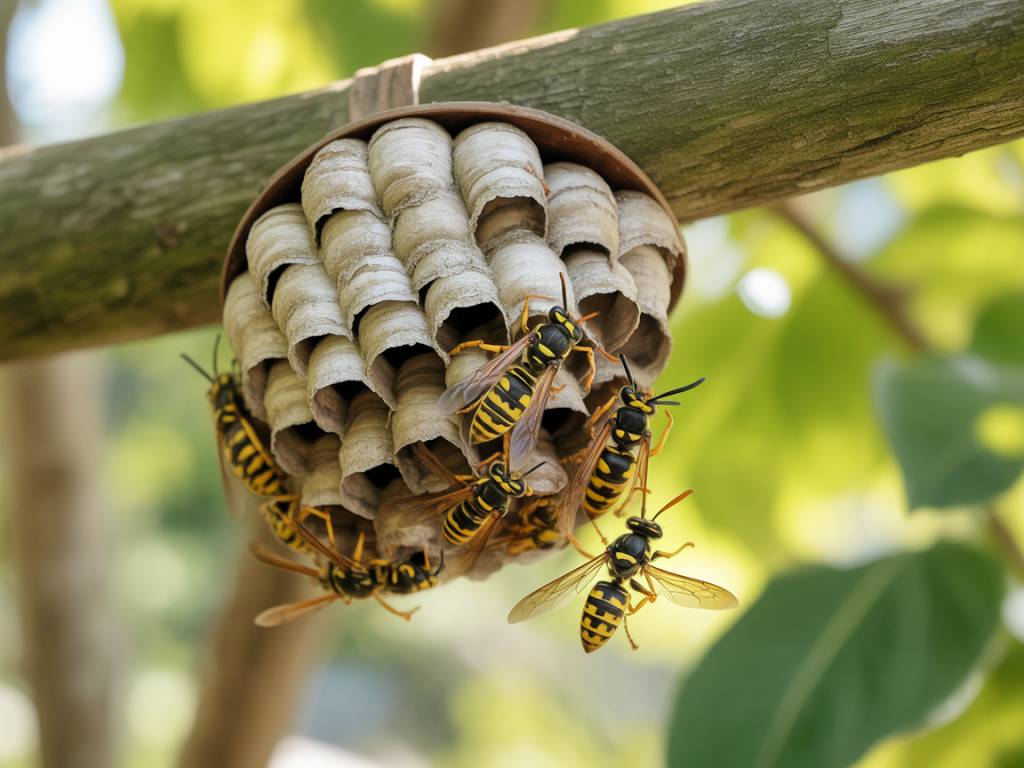
There’s a particular sound to a summer garden in the UK: the soft hum of bees in the lavender, the flutter of wings in the hedge… and sometimes, the unmistakable buzz of wasps who have decided your little patch of green is the perfect place to build a nest.
If you’ve discovered a wasp nest in a small garden, you may feel torn. You want to protect your family, but you also don’t want to harm the helpful pollinators that keep your garden thriving. The good news? There are gentle, natural ways to manage a wasp nest that respect both safety and the delicate balance of your garden.
First things first: is it really a wasp nest?
Before you do anything, it’s crucial to know who you’re dealing with. Many people understandably confuse wasps, bees and even hoverflies. Some of these insects are protected and essential pollinators.
Here are a few simple clues:
- Wasps (common or German wasps in the UK) have smooth, shiny bodies with bright yellow and black stripes. They look quite “polished”. Their nests often look like grey, papery footballs.
- Bees are generally hairier and less sharply striped. Bumblebees are round and fuzzy; honey bees are more slender but still hairy and muted in colour.
- Hoverflies mimic wasps’ colours but have just one pair of wings and don’t sting. They hover in place, as their name suggests.
If you suspect the nest might belong to bees rather than wasps, pause. Many bees are protected in the UK, and they are superb pollinators. In that case, the best approach is often to leave them in peace or contact a local beekeeper for advice.
For definite wasp nests, you still don’t need to leap straight to harsh treatments. Let’s look at the gentlest path first.
Do you actually need to remove the nest?
This may sound like an odd question when you’re feeling watched every time you hang out the washing, but it’s worth asking.
Wasps, like everything else in the garden, have their role. They are voracious predators of garden pests such as caterpillars and aphids, and in late spring and early summer they can be surprisingly helpful allies. Most nests die off naturally in autumn when the first frosts arrive. The queen overwinters elsewhere; the old nest will not be reused next year.
So ask yourself:
- Is the nest far from doors, windows, children’s play areas or seating?
- Are the wasps mostly ignoring you as you go about your garden tasks?
- Do you, or anyone in the household, have a severe allergy to stings?
If the nest is tucked away at the end of the garden and you can easily give it a wide berth, the most natural option is simply to mark off that corner and wait until winter. By then, the nest will be empty and fragile, and you can remove it if you wish, almost like taking down a very delicate paper lantern.
However, if the nest is near your back door, or in a tiny garden where avoidance simply isn’t realistic, then it’s time for more active – but still gentle – measures.
Safety first: protecting yourself and others
Even when choosing natural methods, safety must come before everything else. Wasps will defend their nest if they feel threatened, and several stings can be dangerous, especially for young children, pets or anyone with an allergy.
Before attempting any intervention, keep in mind:
- If you know (or suspect) that someone in your home is allergic to stings, do not tackle the nest yourself. Seek professional help.
- Never disturb a nest in the middle of a sunny, busy day. Wasps are most active in warmth and light. Any action should be taken late evening or very early morning, when they are calm and mostly inside the nest.
- Wear protective clothing: long sleeves, trousers tucked into socks, gloves, a hat and ideally a net or scarf over your face. It’s not glamorous, but it’s much kinder than a sting.
- Always have a clear escape route in mind. Don’t box yourself into a corner of the garden.
And finally, if the nest is large (football-sized or bigger) or wasps are already behaving aggressively, the most natural option may actually be to do nothing yourself and let a trained professional handle it with minimal chemicals.
Natural approaches that are kind to pollinators
When we talk about “natural” ways to get rid of a wasp nest, we’re really talking about three things:
- Encouraging the wasps to move on if possible
- Blocking access to the nest when it’s safe to do so
- Using gentle, targeted methods that don’t harm bees, butterflies or other beneficial insects
Here are some pollinator-friendly strategies to consider.
Try encouraging wasps to relocate
Sometimes, especially with small, newly started nests in spring, wasps can be persuaded that your shed or eaves are not such an appealing home after all.
Options include:
- Disturbance (without destruction)
For very small nests (golf ball to egg size) discovered early in the season, a little regular disturbance near the nest entrance (not directly hitting it) can sometimes persuade the queen to abandon that site. Gently tapping the wood near the nest once a day, or operating a noisy door or window nearby, can make the spot feel unsuitable.
Only attempt this if the nest is tiny and you can stay at a safe distance. Stop immediately if you notice increased aggression. - Artificial “competitor” nests
Wasps are territorial. They rarely build a nest close to another colony. Hanging a fake wasp nest (these are often made of paper or fabric and are widely available online) can sometimes deter them from expanding or rebuilding in the same spot.
While this won’t remove an established nest overnight, it can be helpful in discouraging new construction, especially in a small garden with limited hiding places.
These approaches are wonderfully gentle on pollinators because they don’t rely on sprays or powders that could drift onto flowers or into the soil.
Blocking access once the nest is empty
Many people discover an old wasp nest in a loft, shed or bird box in late autumn or winter. In that case, nature has already done most of the work for you.
When temperatures drop and there is no activity around the nest for several days:
- Wear gloves and a mask (old nests can be dusty).
- Carefully remove the nest by gently twisting or lifting it away from its attachment point.
- Place it in a garden waste bin or compost if you’re comfortable doing so – it’s just plant fibres, after all.
- Seal up entry points such as gaps under eaves, holes in sheds or cracks in masonry with suitable filler, mesh or timber.
This approach is entirely natural, harms no living creature and prevents new queens from choosing the same cosy crevice next spring.
Selective, low-impact removal for awkward locations
Sometimes, despite your best hopes, the nest is simply in the wrong place: beside the only back door, in a tiny courtyard garden, or inside a small shed you use daily. If it’s still relatively small and you’re confident about safety, a very careful, physical removal can be an option.
For accessible, hanging nests (under a shed roof, eaves, or in a bird box):
- Wait until late evening on a cool, calm day when wasps are inside and sluggish.
- Wear full protective clothing.
- Prepare a sturdy container with a tight-fitting lid – a bucket or large box – and line it with a damp cloth or a layer of soil at the bottom to cushion the nest.
- Very gently, place the container underneath the nest, then use a long-handled tool (like a hoe or broom) to dislodge the nest in one motion so it drops into the container.
- Immediately slide the lid across and secure it.
- Carry the container far from houses and gardens – countryside, woodland or scrubby areas away from regular footpaths are best – and leave it open so the wasps can emerge and reorient themselves. Do not shake or crush the nest.
This method is not risk-free, and it’s only suitable for small nests in the earlier part of the season. However, it has the advantage of moving, not killing the colony, and there’s no spray or dust to contaminate flowers where bees and other pollinators forage.
Ground nests: gentle strategies for lawn and borders
Some wasps nest in holes in the ground, often in lawns, under paving or at the base of hedges. In a tiny garden, this can make walking around feel like stepping through a minefield.
Here are some softer approaches:
- Mark and avoid
If the nest is at the far edge of a border or under a hedge, you might simply mark the area with a plant pot, cane or small fence for a few months and instruct everyone to steer clear. This is the least intrusive path and least likely to affect other wildlife. - Encourage them to choose elsewhere (early season only)
When a ground nest is very new and small, gently placing a large, flat stone or paving slab over (not into) the entrance, leaving small gaps at the edges, can sometimes convince the queen this isn’t a good spot. The wasps can still escape and are likely to establish a new nest elsewhere.
Again, do this at dusk, with protective clothing, and never seal the nest completely while it’s active. - Let winter do the work
Ground nests, like aerial ones, die out with the cold. Once there’s no activity around the entrance and the soil is still, you can fill in the hole with soil or sand, then reseed the patch of lawn or replant the area, making it less likely to be reused as a nesting site.
With ground nests in particular, avoid pouring boiling water, soap, or home-made chemical brews into the entrance. These methods can be cruel, often ineffective, and they also damage soil life, including beneficial insects and microorganisms.
Why “natural sprays” can still be bad news for pollinators
You may come across recipes for “natural” wasp killers using things like dish soap, peppermint oil, vinegar or even petrol. While they might sound gentler than commercial pesticides, they can still be highly harmful to bees and other pollinators, especially when used near flowers or in a small, enclosed garden.
Dish soap and many essential oils can coat insects’ bodies and wings, suffocating them or disrupting their ability to fly and navigate. A drifting spray does not distinguish between a wasp and a hardworking bee on your lavender.
For the sake of pollinators – and the wider health of your garden – it’s far better to focus on relocation, timing and prevention than on any sort of kill-on-contact liquid, natural or not.
Making your small garden less attractive to wasps (but still a haven for bees)
The most peaceful way to handle wasp nests is to reduce the chances of them popping up in awkward spots in the first place. That doesn’t mean stripping the garden of flowers or life. It simply means sending gentle signals that certain areas are “already taken” or not ideal for nesting.
Consider these steps:
- Seal the cosy gaps
In late autumn or winter, walk around your garden with a keen eye. Look for gaps under eaves, holes in sheds, cracks in fences or cavities in walls. Seal them with filler, caulk, mesh or timber, depending on the situation. This doesn’t affect pollinators but removes prime wasp real estate. - Manage food and waste
Wasps are particularly drawn to sweet and protein-rich food. Keep bins tightly closed, rinse recycling, and avoid leaving fallen fruit to rot under trees in tiny gardens, where space is limited and scents are concentrated. - Design “wasp-neutral” seating areas
Place your main sitting and dining areas away from dense shrubs, ivy-covered walls and overhangs where nests are likely. In a small space, even shifting a table a couple of metres can make a big difference. - Plant for pollinators with a bit of distance
You can still have your nectar-rich borders. Just try to keep bee magnets like lavender, catmint and buddleia a little away from doors and main paths, so your encounters are with gentle foragers, not with defensive nest guards. - Use decoy nests early in the season
In March and April, hang one or two fake wasp nests in sheltered spots away from your favourite sitting areas. Queens scouting for new homes may decide the space is already spoken for and move elsewhere.
When it’s time to call a professional
There’s no shame at all in deciding that the kindest, safest route for everyone – including the wasps – is to call in expert help.
Seek professional assistance if:
- The nest is large or wasps are already aggressive.
- The nest is inside the fabric of your home (loft, cavity wall, chimney).
- You or someone nearby has a known allergy to stings.
- The nest is in an impossible-to-avoid location in a very small garden – for example, right beside the only exit door.
When speaking to a pest control company, you can ask specifically about:
- Their methods – do they use minimal, targeted treatments?
- How they reduce risks to bees and other pollinators?
- Whether they follow local guidelines and best practice for wildlife safety.
A good professional will be happy to answer these questions and will treat your garden – and its many small residents – with respect.
Living closely with nature, especially in a small UK garden, always means a bit of negotiation. Wasps aren’t the villains of the story; they’re simply looking for a home, just as we are. With patience, gentle tactics and a thoughtful eye on the seasons, you can keep your family safe, protect your precious pollinators, and allow your garden to stay the vibrant, humming sanctuary it longs to be.