


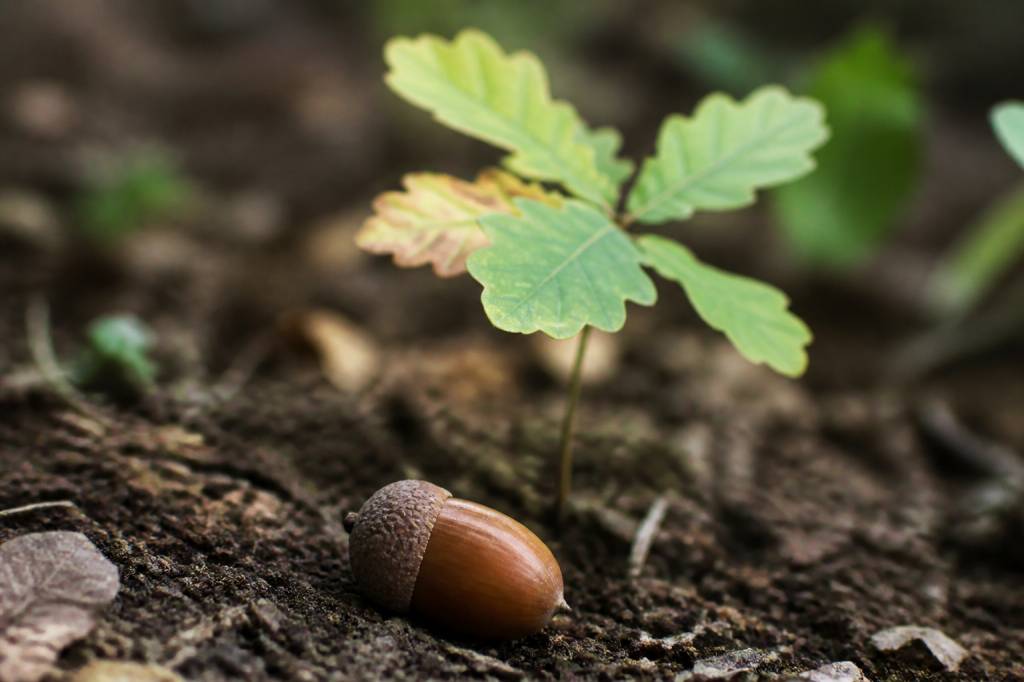
There is something quietly magical about growing an oak tree from an acorn. In autumn, beneath the golden canopy of an English oak, those small brown cups seem almost ordinary. Yet each one carries the possibility of a tree that may outlive several generations of gardeners.
Acorn farming is a simple, natural way to raise oak trees in the UK. It needs very little specialist equipment, but it does ask for patience, observation and a willingness to work with nature’s timetable. Whether you are restoring a hedgerow, creating a wildlife corner or simply nurturing a young tree for your garden, the process begins with one careful walk beneath an oak.
Why grow an oak from an acorn?
Native oaks are among the most valuable trees for British wildlife. A mature oak can support hundreds of species, from caterpillars and moths to birds, bats, fungi and small mammals. Its deeply ridged bark provides shelter, while fallen leaves enrich the soil and create homes for countless tiny creatures.
Growing from seed also gives you the chance to raise a tree suited to its local conditions. An acorn collected from a healthy oak in your area may already be adapted to the soil, rainfall and winter temperatures nearby. It is nature’s own form of local gardening.
There is a practical pleasure in watching the stages unfold: the acorn swelling, the first root appearing, and finally a delicate green shoot pushing into the light. It is a slow project, certainly, but not a difficult one. Oaks are generous trees once they get established.
Choosing the right oak and the right acorns
The two most familiar native oak species in the UK are the English oak (Quercus robur) and the sessile oak (Quercus petraea). Both can grow into magnificent trees, although they have slightly different preferences.
- English oak usually has acorns on long stalks and leaves with small stalks. It is commonly found in lowland areas and tends to enjoy heavier, richer soils.
- Sessile oak has acorns held close to the twigs and leaves with longer stalks. It is often associated with upland and western areas and can cope well with poorer, more acidic soils.
When collecting, choose a healthy, mature tree away from busy roads and areas that may have been treated with chemicals. If you are gathering from land that is not your own, ask permission first. A handful of acorns will do no harm, but collecting large quantities from woodland or protected land may not be appropriate.
Look for acorns that have fallen naturally and are brown, firm and free from obvious holes. Green acorns are usually immature and may not germinate reliably. Avoid any that are soft, cracked, mouldy or shrivelled. A good acorn should feel pleasantly heavy for its size, rather like a tiny nut with a little promise tucked inside.
The simple float test
Once home, place the acorns in a bowl of cool water. Leave them for a few hours, or overnight. Healthy acorns often sink, while damaged or hollow ones tend to float. This is not a perfect test, so do not discard every floating acorn without a glance, but it is a useful first filter.
Remove the caps and inspect the nuts. A small hole may indicate an acorn weevil larva, which has already made lunch of the inside. These acorns are unlikely to grow successfully. Select the firm, intact ones and keep them cool while you prepare their containers.
When to sow oak acorns in the UK
Fresh acorns are best sown in autumn, soon after they fall. This follows their natural rhythm and allows the young root to develop during the cooler months. In much of the UK, September to November is the ideal window, although the exact timing varies with the season and location.
Do not let the acorns dry out. Oak seeds are often described as “recalcitrant”, meaning they do not store well when dried. If you cannot sow them immediately, place them in a loosely closed bag with slightly damp compost, leaf mould or vermiculite. Keep them in a cool place, such as a shed or refrigerator, but never allow them to sit in waterlogged material.
Check stored acorns regularly. Remove any that become mouldy and make sure the surrounding material remains just damp. They should feel cool and fresh, not wet enough to resemble porridge.
Preparing containers and compost
Oak seedlings develop a long taproot surprisingly quickly, so shallow seed trays are not ideal. Choose deep pots, root trainers or tall recycled containers with generous drainage holes. A container around 20–30 centimetres deep gives the first root room to grow.
Use a free-draining, peat-free compost. A mixture of peat-free multipurpose compost with horticultural grit, perlite or fine bark can work well. The aim is moisture without stagnant conditions. Waterlogged compost can cause the acorn to rot before it has a chance to wake.
- Use clean containers to reduce the risk of fungal disease.
- Check that drainage holes are open and not blocked by stones or compacted compost.
- Fill the pot almost to the top, leaving a little space for watering.
- Sow one acorn per container if possible, making later planting much easier.
How to plant an acorn
Place the acorn on its side or with the pointed end slightly downwards, then cover it with around two to three centimetres of compost. Nature is not especially fussy about orientation, and the root will usually find its way down, but shallow planting prevents the emerging shoot from using too much energy.
Water gently until the compost is evenly moist. Label each pot with the date and the oak species or collection location if known. This little detail becomes surprisingly useful later, especially when you have several pots that all look very similar.
Position the containers outside in a sheltered spot. A cold frame, unheated greenhouse or protected corner near a wall can provide useful shelter, but the pots should still experience natural seasonal temperatures. Oaks do not need a warm indoor windowsill. In fact, central heating is more likely to confuse or dry out a young seedling than help it.
Protecting acorns from hungry visitors
In the wild, acorns are an important food source for squirrels, mice, jays and other animals. In a pot, however, one determined squirrel can undo an afternoon’s work in seconds. Cover the containers with wire mesh or place them inside a secure cold frame. Ensure the mesh is held firmly down, because squirrels are excellent gardeners when the garden is not theirs.
Slugs and snails may also nibble newly emerging shoots. Keep pots raised slightly off the ground and inspect them regularly, particularly after wet weather. Avoid scattering harmful slug pellets around wildlife-friendly growing projects. Hand-picking, copper barriers or natural predators are kinder options.
Germination and early care
Some acorns begin rooting in autumn, while others wait until late winter or spring. You may see a small white root first, followed by a green shoot. Keep the compost lightly moist but never saturated. During cold spells, growth may pause completely; this is normal and not a sign that the project has failed.
As the seedling appears, give it plenty of daylight. A bright outdoor position is best, but protect the young leaves from harsh winds and late spring frosts. If a sudden cold snap is forecast, move the pot into an unheated shed or cover it loosely with horticultural fleece. Avoid placing fleece directly against delicate foliage for long periods.
Do not feed the seedling immediately. The acorn contains its own initial food supply, and a rich fertiliser can encourage soft, rapid growth that is less resilient. Once the tree is well established and producing fresh leaves, a very light application of a balanced, slow-release fertiliser may be considered, although good compost is often sufficient.
Watering young oak trees
Young oaks need consistent moisture while their roots are developing. Check the compost with your finger and water when the surface has begun to dry. In warm summer weather, containers may need attention every day or two. Water slowly so that moisture reaches the full depth of the pot.
At the same time, remember that an oak is not a bog plant. Never leave the pot standing in a saucer of water, and do not water automatically during prolonged wet weather. The best habit is to look first. The leaves, compost and weather will usually tell you what the tree needs.
Moving seedlings into larger pots
After the first growing season, inspect the drainage holes. If roots are beginning to circle or emerge from the base, it is time to move the seedling into a larger, deeper container. Handle the root ball carefully and avoid pulling the stem.
Lift the tree by supporting the compost and root mass rather than gripping the delicate shoot. Plant it at the same depth as before, firm the compost gently and water thoroughly. A deeper pot is more important than a very wide one, as the young oak is still keen to develop its downward-growing root.
Try not to keep the tree in a pot for too many years. Container-grown roots can become congested, and a root-bound oak may struggle after planting. In many cases, a healthy seedling can be planted into the ground after one or two years, depending on its size and the site.
Choosing a permanent planting place
Before planting, think about the oak’s future size rather than its current appearance. A small sapling can eventually become a broad, substantial tree with a wide root system and a generous canopy. It should be well away from buildings, drains, walls, overhead wires and areas where heavy shade would be a problem.
Choose a sunny or lightly shaded position with enough room for the tree to mature. Clear competing grass and weeds from a circle at least one metre wide. Grass can take more water and nutrients than a young tree can afford to lose.
Plant during the dormant season, usually from late autumn to early spring, provided the ground is not frozen or waterlogged. Dig a hole wider than the root ball but no deeper. Place the tree so that the top of the root ball sits level with the surrounding soil. Backfill with the excavated earth, firm gently and water well.
A short stake may help in an exposed garden, but avoid tying the trunk too tightly. The tree needs a little movement to develop strength. Use a soft tree tie and check it regularly as the trunk grows.
Aftercare in the first few years
The first two or three years are the most important. Water deeply during dry spells, especially between April and September. A slow soak once a week is generally more useful than a quick splash every evening. Keep the area around the trunk free from weeds and grass, and apply a light mulch of well-rotted compost or woodchip.
- Keep mulch away from direct contact with the trunk to prevent rot.
- Protect young trees from rabbits, deer and other browsing animals with a suitable guard.
- Inspect stakes and ties each spring and loosen or remove them when no longer needed.
- Do not prune heavily unless there is a damaged, dead or crossing branch.
- Watch for drought stress, including limp leaves, browning edges and premature leaf fall.
Some leaves may be nibbled, and a few may turn brown during a hot summer. This does not always mean the tree is seriously ill. Young oaks are remarkably adaptable, but regular watering and protection give them the best possible start.
Growing oaks for wildlife and future generations
Acorn farming can be more than a gardening experiment. A few well-grown saplings can strengthen a boundary, restore a corner of a field or create a future habitat corridor. If you are planting several trees, vary the spacing and consider mixing oak with native companions such as hawthorn, hazel, birch or field maple.
Leave some fallen leaves beneath established trees, allow native wildflowers to grow nearby and resist the urge to make every inch perfectly tidy. An oak’s greatest gift is not just its beauty, but the living community it gathers around itself.
There is a particular pleasure in planting a tree whose shade you may never sit beneath. Perhaps a child, a grandchild or a passing blackbird will enjoy it instead. Begin with a few sound acorns this autumn, give them a little protection and patience, and let the quiet work of the seasons begin.